
From a record-setting debut to an FIA International Court of Appeal case: the events of June 6–7 that changed Alumitec Racing’s 2026 season
Alumitec Racing entered the NASCAR Euro Series with a different philosophy and ambitious objectives.
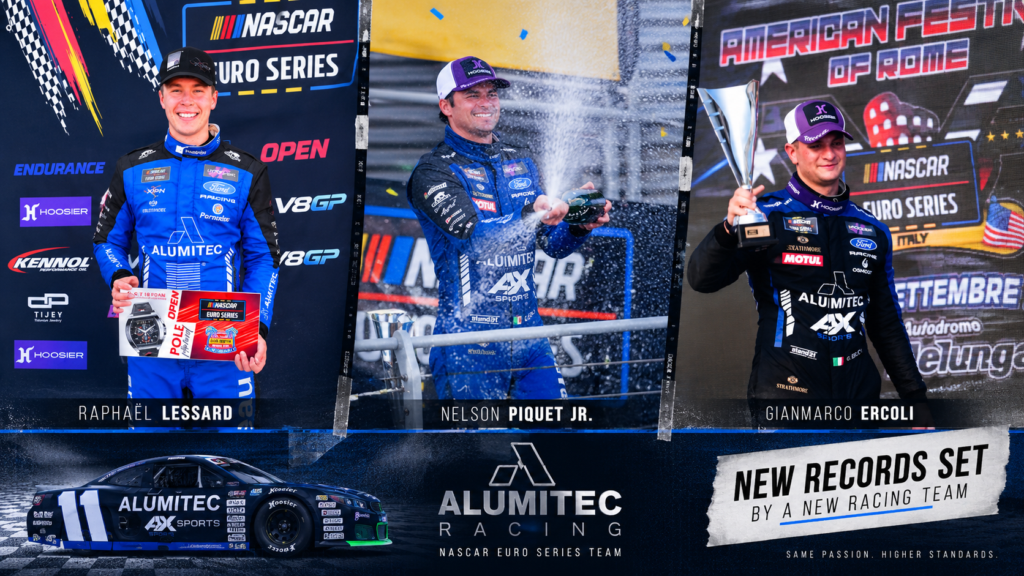
According to the team, Alumitec Racing has broken multiple NASCAR Euro Series records for a new organization, establishing itself as a competitive force in a remarkably short period of time.
Its driver model is also different. Alumitec Racing says it is the only team on the NASCAR Euro Series grid operating with an entirely professional driver structure: its drivers are hired and paid to race. None of Alumitec Racing’s drivers buys a seat or brings funding in exchange for driving the car.
The philosophy is simple: select drivers for their experience, talent and ability to compete for victories and championships.
By June 2026, however, Alumitec Racing’s season was about to take an unexpected turn.
What happened at Brands Hatch on June 6–7 ultimately developed into a dispute that will be heard by the FIA International Court of Appeal on October 15, 2026, under Case ICA-2026-12-13.
SATURDAY: MORE THAN THREE HOURS OF TECHNICAL INSPECTIONS
On Saturday, June 6, Gianmarco Ercoli won the PRO/V8GP race on track in the #11 Alumitec Racing car. However, following contact during the race, Ercoli received an in-race penalty. That penalty affected his classified result, placing him fifth in the official classification.
Later that day, Raphaël Lessard drove the same #11 in the OPEN category and finished second.
Following the races, the #11 entered Parc Fermé, where it remained for more than three hours, from approximately 5:29 p.m. until 8:42 p.m.
During this extended period, officials performed multiple technical inspections. Alumitec Racing fully cooperated throughout the process.
The checks included verification of the engine seals and a compression-ratio test using a K-Tec device a more extensive examination of an important internal engine performance parameter rather than simply an external visual inspection.
According to the appeal, the compression ratio complied with the applicable technical regulations and the #11 was declared compliant before Parc Fermé was lifted.
All seals protecting the engine were also inspected by the technical officials and were declared intact and compliant, with no anomaly reported. The appeal records that the engine seals were checked during the event and no anomaly was detected.
The origin and sealing of this engine are particularly important.
The engine had been exclusively supplied and prepared by championship promoter Team FJ. Under the technical framework described in the appeal, competitors cannot open these engines without authorization from the Technical Delegate or Team FJ.
According to Alumitec Racing, the engine was protected by original GM single-use seals that must be irreversibly broken to open the engine, together with two additional seals installed on engine components under the promoter’s control.
In practical terms, Alumitec maintains that its engineers and mechanics could not access or modify the engine’s internal components without disturbing or breaking those seals.
COMPLIANT BUT MECHANICALLY CONCERNING
For Alumitec Racing, Saturday therefore ended with an important sequence of facts: more than three hours in Parc Fermé, multiple technical inspections, a compression-ratio test, verification of all engine seals and no reported technical non-conformity.
But regulatory compliance did not mean that Alumitec’s engineers and mechanics were free of mechanical concerns
The team suspected that the engine’s lifters were not operating at full capacity, potentially affecting its mechanical performance.
Alumitec therefore faced a difficult decision on Saturday evening.
One option was to replace the engine. But with extremely limited time before Sunday’s program, that would have required the team’s engineers and mechanics to work through much of the night.
The other option was to play everything on Sunday: keep the inspected and officially compliant engine in the #11 and hope that Gianmarco Ercoli’s talent could compensate for the mechanical weakness the team feared was developing.
Alumitec chose the second option.
SUNDAY: THE WARNING BECOMES REAL
Sunday’s PRO/V8GP race initially appeared to justify that decision.
According to the team, Gianmarco Ercoli and Alumitec Racing were in complete control of the race, with the #11 running strongly at the front despite the mechanical concerns identified the previous evening.
Then, with only seven laps remaining, everything changed.
The #11 experienced a sharp and abnormal drop in engine oil pressure, forcing Gianmarco Ercoli and Alumitec Racing to retire the car from the race. The appeal confirms that a sudden abnormal loss of oil pressure occurred during Sunday’s race.
What happened next transformed a mechanical issue into the dispute that would ultimately reach the FIA International Court of Appeal.
THE REQUEST TO SEIZE THE ENGINE
According to Alumitec’s account, between approximately 4:20 p.m. and 4:35 p.m., the Technical Delegate, accompanied by a technician working for Team FJ, arrived at the Alumitec Racing garage and requested the seizure of the engine for further investigation.
The appeal states that the equipment required to conduct the intended investigation was not available at Brands Hatch. The engine would therefore have to be retained and subsequently examined away from the circuit.
This is where the interpretations of what happened fundamentally diverge.
The stewards characterized the situation as a refusal to allow the engine to be collected and dismantled for inspection. That finding ultimately resulted in the exclusions of Gianmarco Ercoli and Raphaël Lessard.
Alumitec Racing strongly disputes that characterization.
Its position is that the team never refused a technical inspection. According to the appeal, the disagreement concerned the conditions surrounding the seizure, transportation and retention of the engine, particularly because it was travelling under an ATA Carnet international laws
Alumitec says it proposed preserving the engine under seal, With the truck placed under seal by a court appointed bailiff
maintaining its traceability, leaving the United Kingdom in compliance with its customs obligations and subsequently making the engine available for inspection under controlled conditions.
The distinction is central to the case:
Was this a refusal of inspection or a disagreement over the seizure and retention of an already inspected, officially compliant and sealed engine for an examination that could not be performed at the circuit?
The events of those few hours at Brands Hatch would ultimately affect two drivers, championship points and the course of Alumitec Racing’s 2026 season.
On October 15, 2026, the FIA International Court of Appeal is scheduled to hear Case ICA-2026-12-13.
ON THE NEXT ARTICLE 2: THE ENGINE WAS ALREADY INSPECTED AND DECLARED COMPLIANT.
Alumitec Racing Press Room
In collaboration with AX SPORTS